
News & Media
Myanmar: rebuilding one year after the earthquake
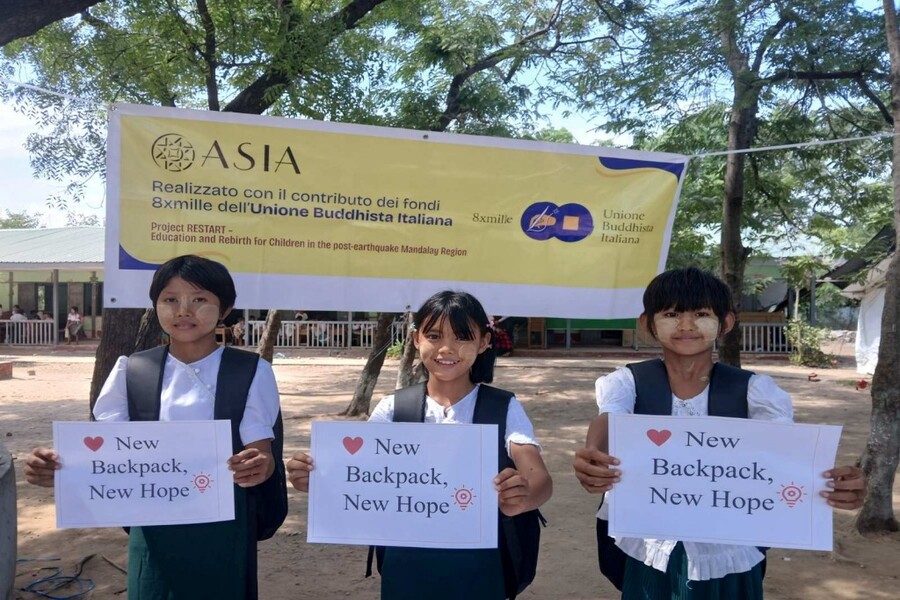
RESTART, the project realised by ASIA thanks to the 8xmille funds of the Italian Buddhist Union in the Mandalay Region, in Myanmar, has come to an end. Fifteen months of work, from May 2025 to July 2026, to put back on their feet the schools destroyed by the earthquake of 28 March 2025.
The earthquake, of magnitude 7.7, struck central Myanmar severely damaging the building stock, including numerous public and monastic schools. In the townships of Kyaukse, Sintgaing, Yamethin and Pyawbwe thousands of children found themselves without usable schools, hubs of health and of social and community education.
Listening before intervening
Before starting the works, the staff visited the villages and convened assemblies with headmasters, teachers, parents, village chiefs and those in charge of the monastic schools.
The communities expressed right away the need for a proper reconstruction, for teaching materials, for tools and places to restart everyday life and hope. To respond to these requests, the works to rebuild the schools were started, together with the deliveries of the school kits and the creation of new water systems.
Moreover, at the request of the families, programmes on the prevention of addictions were designed and realised, a problem deeply felt among the young people of the country.
Then, for each school a committee was set up that followed the building sites step by step together with ASIA’s technicians, in order to keep the dialogue with the communities and the recipients of the interventions always alive.
The results
All eight of the selected schools were rebuilt or rehabilitated. The works, started in January 2026, were completed between February and June: the last three shortly before the beginning of the new school year. At the Lae Pyin Thar Monastery School in Kyaukse, where the building had collapsed, there are today two new classrooms; at the Hmannen Monastery School in Pyawbwe, which hosts over 600 children, three classrooms accommodate 205 students.
Six schools also received new water systems, with 1,500-litre tanks and, where necessary, a well.
Alongside the building sites, the project distributed over 1,100 school kits and 1,251 backpacks, together with desks built by local craftsmen and blackboards for the classrooms. About 1,700 students took part in awareness days on addictions and 160 teachers were trained in the management of natural disasters and on hygiene in emergencies, learning how to build the safety plan of their own institute.
The project concretely built new places of restart for a territory deeply marked by a serious humanitarian emergency. The model pursued is the one ASIA has always applied in emergency and post-emergency contexts. ASIA works to transform the crisis into an opportunity for sustainable development through the reconstruction of houses, schools and clinics, and the activation of programmes that favour the capacity building and the economic and social resilience of the affected communities.
Pubblicato il
24/07/2026