News & Media
Green School: you don't only learn to count, but to make the difference
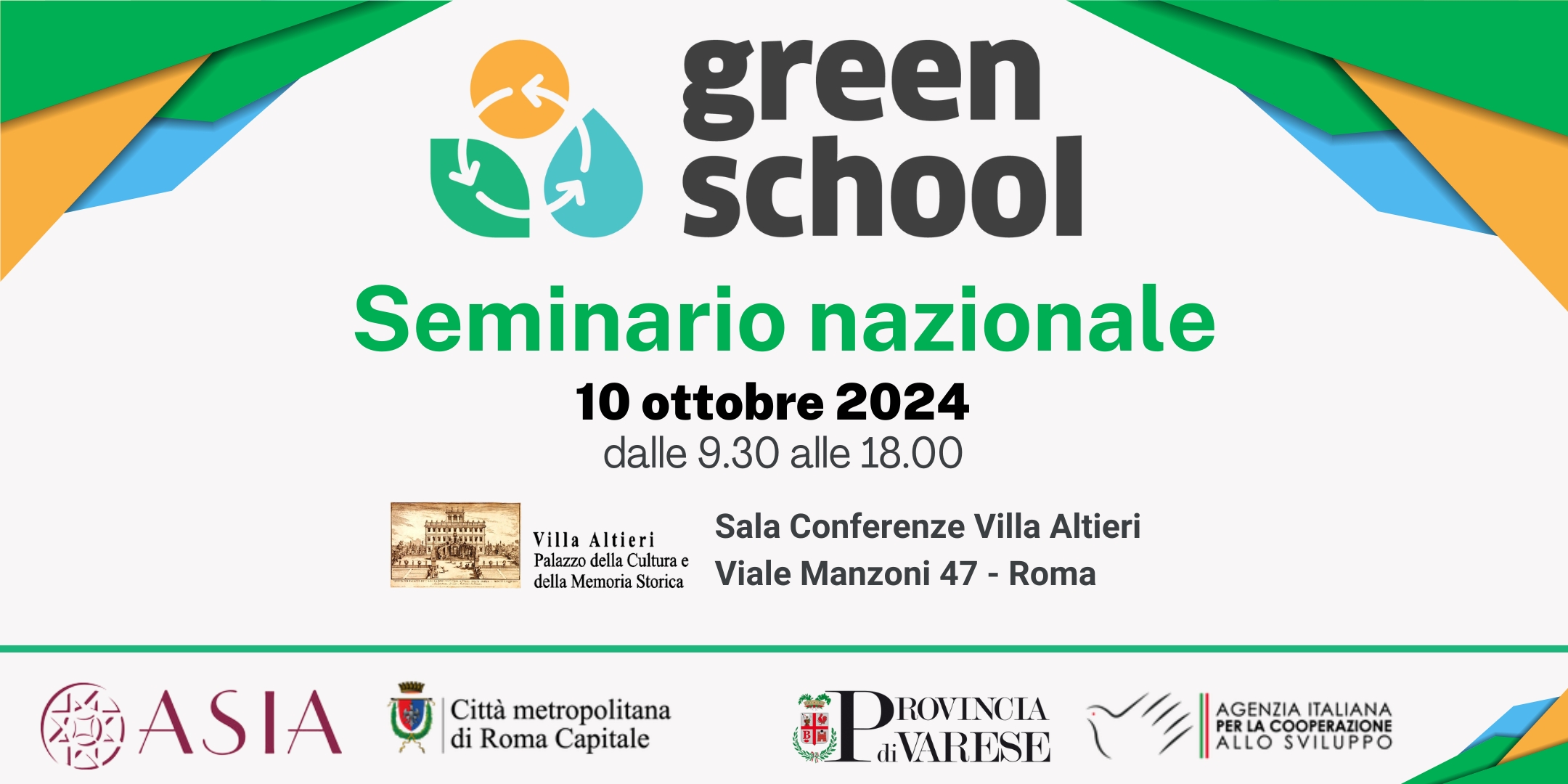
10 October was a crucial date for the Green School Program: in Rome, during the National Seminar, the results of the last two years of activity were presented, in which the program developed within the call for Global Citizenship Education funded by AICS. This meeting represented an opportunity to discuss the contribution of the Italian territories to the global sustainability goals, but also to compare, exchange ideas and relaunch the program. The theme was not only that of “doing the math” with environmental resources, but of discovering how schools, associations, institutions and communities are already making the difference.
The Green School program, born in 2009 from an idea of Agenda 21 Laghi and CAST ONG ONLUS, with the support of the University of Insubria, has seen a constant growth. Supported by the Province of Varese and funded by several institutions and calls, it has extended to the provincial and regional level. In these 15 years, the program has evolved and adapted to the needs of the territories, from Cagliari to Aosta, passing through Livorno, Cremona and the leading city Varese, up to Rome, where on 10 October the national seminar will be held.
Reducing to multiply sustainability
If at the school desks one learns to do sums and subtractions, there are schools where numbers become the protagonists of making the real difference. In the last two years, the Green School Program has involved 299 schools in 12 Italian provinces. These figures add up to the institutes that have been taking part in the project for a long time, reaching a total of 104,309 students and 711 school buildings, committed to reducing their carbon footprint.
Subtraction is not just a mathematical operation: in the context of the program, reducing emissions becomes a choice that educates to environmental sustainability. The participating schools commit themselves on six fundamental areas: energy saving, reduction and proper management of waste, sustainable mobility, reduction of food waste, water saving, and protection of the environment and biodiversity. Thanks to this commitment, they can obtain the Green School certification.
The Gren School National Seminar of 10 October
The National Seminar of 10 October was a key moment to discuss the progress of the program. In the morning a round table was held, entitled: “Education for sustainable development: the contribution of the territories to the global goals”, in which institutions, associations and schools shared experiences and strategies for an increasingly effective education. In the afternoon, the space was dedicated to the numerous national and international networks that are engaged in environmental education, creating a synergistic dialogue between different realities.
Adding value with training
“A Green School is a school that commits to reducing its impact on the environment and to educating its pupils to an active attitude towards the planet”, one reads on the website of the program. Where you take away, space is left to add: trainings for students and teachers are offered. In the last year alone, the training opportunities were 121, but over the 15 years of activity, the number has reached the thousands. The occasions for learning together have multiplied, starting from the simplest formula, the one to calculate how much CO2 has been saved: since 2009 there have been 132 tonnes, equal to about 30 Olympic pools, that is 2.2 kg per pupil. The program, however, does not stop at mathematics. The educational offer also includes empathy, mindfulness and the skills of intelligence and motivation. A real “toolbox” that provides practical and theoretical, technical, cognitive and emotional tools, to strengthen a new ecological awareness not only in the new generations, but also among teachers and parents.
The impact beyond school: an involved territory
But the Green School Program involves not only students, but entire communities. Through the collaboration with local institutions, associations and public service companies, a network of partnerships is created that amplifies the impact of the project, including within the reflections on the environment also social aspects such as the relations between North and South of the world and global citizenship.
Among the recent examples of participatory design, the construction of a geodesic dome at the Keplero High School of Rome stands out, built with eco-sustainable materials thanks to the support of the NGO ASIA and the collaboration with the Metropolitan City of Rome Capital and AICS. This space not only represents an example of sustainable architecture, but is open to the territory for events and open-air lessons.
Making the difference, together
The National Seminar of 10 October was therefore a special occasion to compare the results achieved and to imagine new solutions together. To sit at the table of change and to go back to the desks of a school that goes beyond the walls of the classroom, which includes all the spaces we go through. Taking part is a way to make the difference, under the sign of the “minus” as regards waste and environmental impact, and of the “plus” as regards collective actions towards a greater sustainability.
Pubblicato il
18/10/2024