News & Media
The Bön and its sciences
The Bön, together with Buddhism, is one of the two organized religious forms of Tibet.
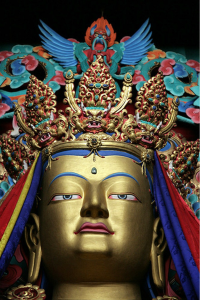 It is an ancient pre-Buddhist religious and spiritual tradition that outlines the foundations of the culture and history of Tibet. Its followers are called bön po. According to tradition, the reformer of the ancient Bön was a master from Zhang Zhung, Shenrab Miwoche (gShen rab mi bo che), who is said to have lived before Śakyamuni at the beginning of the second millennium BC. His teachings have been divided according to several classifications, among them the one into Twelve Sciences (shes pa bcu gnyis), which appears to be the oldest.
These classifications include a complex set of magical-ritual knowledge and practices, mostly apotropaic, carried out by specific bön po priests, who generally stood beside the kings in order to perform propitiatory rites. As stated by Chogyal Namkhai Norbu, etymologically speaking, the term Bön derives from the verb bön pa, which means “to recite sacred formulas”: indeed the power of its practitioners derived from the recitation of mantras, sounds capable of influencing particular zones of energy. Through the vibrations of the mantras the ancient followers of the bön came into contact with the invisible energies and with the occult forces that govern existence and managed to control them (Norbu, 2021:27).
 The classification of the bön po teachings into Twelve Sciences includes knowledge and rituals of every kind, each tied to a particular aspect: there are rituals of protection, of purification, of healing, of divination and so on. The Sciences we focus on today are: the Bön of Astrology, the Bön of Medicine, the Bön of the Deer and the art of flight, the Bön of Juthig divination.
The Bön of Astrology
According to tradition, astrology, the science that governs the order of existence, has as its principal repository ‘Phrul bu chung, son of Shenrab Miwoche (the reformer of the Bön). It is based on three hundred and sixty astrological methods called ‘hidden peaks’ (gab rtse). They are peaks because years, months, days etc. are conceived as periods of time with culminating points which, if seized, can immediately produce positive or negative results for people. They are hidden because the various periods of time are governed by supernatural beings, not perceptible to the 5 senses: we know they are there, but they are as if hidden.
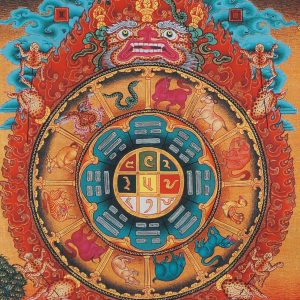 The hidden peaks are summarized in 4 astrological and ritual methods:
- the mirror of the manifestations of the hidden peaks, represented as a turtle lying on its back;
- the diagrams of the seats of the parkha and of the mewa: the parkha are the trigrams linked to the elements, while the mewa are the characteristic signs of positivity or negativity that recur during the astrological time cycles.
- the time cycle of the elements;
- the chuzlag, the astrology of the interdependence of actions, which consists of the system for calculating the birth horoscope called tserab letsi, lit. ‘the calculation of the actions of past lives’.
The 9 mewa, the 8 parkha and the 12 animals (associated with the cycle of 12 years) are always represented at the centre of the diagram of the hidden peaks. The aim of these rituals is to face the different circumstances of life and death. The response obtained from the astrological calculations is indispensable in all the circumstances of life. For example, when a child is born, in order to discover the adversities or fortunes he or she may encounter in life and to indicate how to ward off the former and favour the latter, the birth horoscope is drawn up according to the astrology of past lives.
The Bön of Medicine
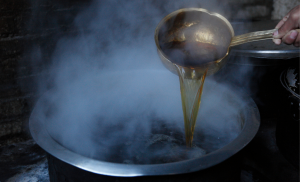
The medical knowledge and the various healing methods of the Bön are said to have been handed down by Shenrab Miwoche (the reformer of the ancient Bön) to his son Chebu Trishe and to other disciples known as the “eight wise ones of medicine”. Disorders can be of two kinds: physical illness or dön, lit. “provocations”, that is, invisible and harmful influences caused by external energies, for example by supernatural beings: in the case of the dön, through divination and astrological calculations one can understand which class of beings caused the disorder and how it can be cured.
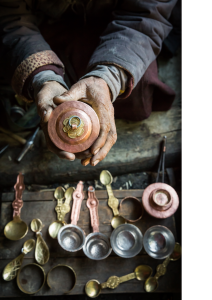 The fundamental principles for making medical diagnoses are:
- understanding the primary and secondary causes;
- identifying the type of pulse;
- assessing health and illness through the urine;
- examining the signs of death or of recovery.
The healing methods are related to behaviour, diet, medicines and external interventions:
“First of all the illness must be treated with behaviour, but if this is not enough a diet must be adopted. If even this fails to overcome the illness, medicines will have to be taken. As the last remedy, the various therapeutic techniques are applied” Nor bu ’i phreng mdzes (The precious necklace of jewels) by Jñānadhara (VIII century).
 Who are the Dön?
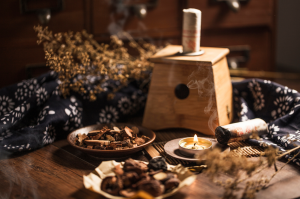
About the Dön, the “provocations of energy”, there are several classes of non-human beings that have the ability to influence a person’s spheres of energy: they can be gods (Lha), demigods (Lha Min), hungry spirits (Yi Dag), beings that send curses (Che Dem) etc. Dön literally means to doubt: it in fact refers to a person who is influenced or ‘provoked’ by something that makes a doubt arise in them, with the result that the doubt takes root inside them. More specifically, the Dön influence those people who are inclined to receive negativity. When one suffers the provocation of a Dön it is not enough to treat oneself with diet, behaviour and medicines: a rite strictly bound to the circumstance and to the class of Dön must be performed. Afterwards, the person’s state of health can be rebalanced through external interventions such as bloodletting, moxibustion or the application of needles.
The Bön of the deer and the art of flight

“It seems that this Bön is at the basis of the magical faculties attributed to the bönpo, of flying riding a drum” (Norbu, 2021:298).
This science comprises a great variety of rites that serve to ward off dangers of death, illnesses and disorders caused by gods, serpents semi-divine, demons etc. The deer is connected to the rites for obtaining good fortune. Among the different rites there is, for example, the rite of the ‘deer with branched antlers’, still practised today. It is divided into three phases. The first is a preparatory phase in which a deer is modelled out of yellowish clay and powdered precious materials, then painted in different colours. In the second the myth of origins is expounded, and in the third the negative influences against which the rite operates are explained.
The Bön of Juthig divination
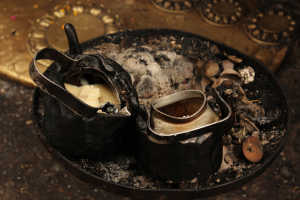 The divinatory methods, known by the name of Mo, are divided into several categories. Among these is the Juthig, lit. ‘small cords’, precisely because it makes use of cords. It is a method that since antiquity has been widely practised in Shang Shung and in Tibet.
This method belongs to the Science of Prosperity, whose purpose is to benefit beings with the intention of helping oneself and others. Before performing the divination, the ‘seven gods of prosperity’ must be propitiated with mantras and invocations. Then the small cords must be prepared by tying knots and making offerings to the gods. The elements on which the divination is based are the knots, which are interpreted by the officiant, who gives a response. A great many knots can be tied but the fundamental ones are 33, that is, 24 “pure’ knots and 9 ‘impure’ knots.
Bibliography
Chögyal Namkhai Norbu, 2021: The narratives, the symbolic languages and the Bön in ancient Tibet, Shang Shung Publications
Pubblicato il
18/11/2021