
News & Media
Nepal does not ask for charity, but for justice
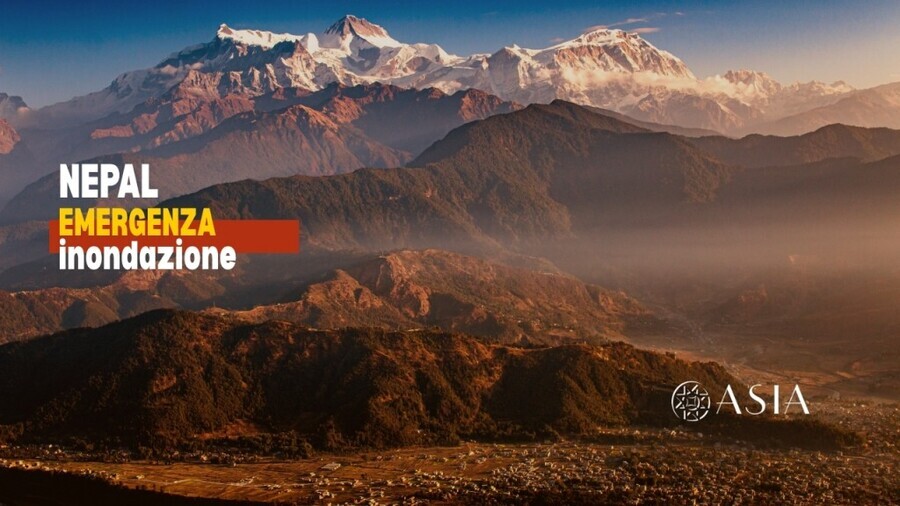
After the Bhotekoshi disaster, Nepal asks the international community to recognise a climate responsibility: not only humanitarian aid, but compensation for losses and damage. At the centre of Kathmandu's new strategy there is also the Fund for Responding to Loss and Damage.
On 26 August the Bhotekoshi river, in the north of Nepal, turned into a destructive force without precedent in the recent memory of the Country. An enormous mass of water, ice, rock, mud and debris crossed in a few minutes the valleys of Rasuwa, Nuwakot and Dhading, sweeping away houses, roads, bridges, schools and energy infrastructure.
The disaster has left behind a deeply transformed territory. According to the first assessments, about 1.6 million people were affected by the event and thousands of buildings are reported damaged or destroyed. The cost of the reconstruction could reach 4-5 billion dollars.
But while the search for the missing and the emergency interventions continue, Kathmandu is opening another match, this time on the international level.
FROM AID TO CLIMATE JUSTICE
Foreign Minister Shisir Khanal announced a change of perspective: Nepal does not want a catastrophe of this magnitude to be considered exclusively a matter of humanitarian aid.
The government is asking for “justice and compensation”, climate justice and compensation, arguing that the large emitting countries must take on a part of the consequences of the climate crisis.
The position is particularly significant for a country like Nepal. Its share of global emissions is minimal, while its exposure to climate change is high. The Himalaya is warming and glacial environments are undergoing profound transformations, with consequences on the stability of the slopes, on the glaciers and on the water systems.
This does not mean that every single extreme event can automatically be attributed to climate change. But it means that climate change is modifying the risk conditions in which these events occur. The Nepalese government has also underlined that the risks for Himalayan communities are increasing together with the climate crisis.
WHAT IS LOSS AND DAMAGE?
It is in this context that the Fund for Responding to Loss and Damage (FRLD). comes into play.
The fund was born from one of the most controversial and important issues of climate diplomacy. At COP27, in 2022, governments decided to create new financial mechanisms to support developing countries particularly vulnerable to the effects of climate change. At COP28, in 2023, the fund formally became operational.
Its aim is to address what are defined as loss and damage: economic and non-economic losses and damage associated with the effects of climate change, both those caused by extreme events and those linked to phenomena that develop slowly.
The distinction is important. International climate policy traditionally acts on two fronts.
- Mitigation: reducing emissions to limit global warming.
- Adaptation: helping communities prepare for the consequences of climate change.
But what happens when it is no longer possible either to avoid or to fully adapt to an impact? When a house is swept away by a flood, when a road is wiped out, when a harvest is lost, when an entire community has to abandon its own territory, we are facing losses that cannot simply be “adapted”. This is the issue at the basis of Loss and Damage.
IT IS NOT A FUND FOR AUTOMATIC COMPENSATIONS
A clarification is needed here.
The Fund for Responding to Loss and Damage is not a court and does not establish which countries are legally responsible for a given disaster. There is no automatic mechanism through which an affected country presents an invoice to an emitting country and receives a compensation proportional to historical emissions.
The fund is instead a multilateral financing instrument, created to support vulnerable countries in addressing the losses and damage associated with climate impacts. Its operation is entrusted to an independent Board, while the World Bank plays, for an initial period, the role of host and trustee. And it is precisely this distinction that makes Nepal's strategy interesting.
Kathmandu is pursuing two requests at the same time. On one hand it asks the Loss and Damage Fund for urgent financial support to address the consequences of the disaster. On the other it argues, on the political and diplomatic level, that the large emitters must compensate the countries that suffer disproportionate consequences of the climate crisis. The two positions share the same underlying principle, but do not constitute the same mechanism.
THE FIRST REAL TEST
The Nepalese request also comes at a crucial moment for the new fund. The FRLD represents an important achievement for vulnerable countries, but it still has to prove that it can turn the principle of climate solidarity into concrete, accessible and sufficiently fast resources. Nepal's case could therefore take on a meaning that goes beyond its borders.
If a mountain country among the most vulnerable to climate change suffers a catastrophe that requires billions of dollars for the reconstruction, the question becomes inevitable: how adequate is the current architecture of climate finance compared to the real dimension of the losses?
The World Bank itself recognises that the fund was created to fill a fundamental gap in international climate finance, supporting vulnerable countries in the face of extreme events and slow-onset phenomena. But the distance between the available resources and the needs is still enormous.
WHY NEPAL CONCERNS EVERYONE
The issue does not concern only the communities living along the Bhotekoshi and the Trishuli. The Himalaya is one of the great water reserves of the planet. Its glaciers feed river systems on which the agriculture, the energy and the water supply of millions of people in South Asia depend.
When a glacier collapses, when a river suddenly changes course or when a valley is hit by a wave of water and debris, the effects can propagate far beyond the place where the phenomenon originated. The Bhotekoshi disaster therefore shows with particular evidence one of the characteristics of the climate crisis: those who are most exposed are not necessarily those who contributed most to creating it.
It is a matter of responsibility, but also of equity. Nepal is trying to turn this awareness into a precise diplomatic position. Its request is not only: “help us rebuild”.
It is: you recognise that the cost of the climate crisis cannot fall above all on those who contributed least to causing it.
FROM NEPAL A REQUEST TO THE WORLD
The real challenge, now, will be to turn the principle into action.
Sufficient and accessible funding is needed to address the losses and the damage. Investments in adaptation are needed, increasingly effective monitoring and alert systems, infrastructure capable of resisting extreme events and a drastic reduction of global emissions. And above all it is necessary to overcome the idea that climate solidarity is a form of charity. For Nepal, the Bhotekoshi disaster is also a question addressed to the international community: who pays the price of a crisis that not everyone contributed to creating in the same way?
The answer Kathmandu is giving is clear. Nepal does not ask for charity. It asks for climate justice.
Pubblicato il
03/09/2026