News & Media
Notes from Tibet
Notes from Tibet
Exploring the melody and spirituality of the ritual musical instruments
Music is a universal form of art that crosses cultural and linguistic borders, touching the hearts of people all over the world. In Tibet too music has very deep roots. Indeed, the Tibetan musical instruments reflect the rich spirituality, culture and history of this unique region, and their sounds offer an incredible sound experience.
Despite the social and political challenges that Tibet has faced over the years, music continues to play a vital role in the preservation of the cultural identity. These instruments are not only vehicles of artistic expression. They are bridges that connect the past with the present and the future, connecting the individual with his spiritual world.
Each instrument has its own meaning and its own peculiarities, and they are really many. Therefore we will go and discover together only a few of them:
Damaru, ཌ་མ་རུ་
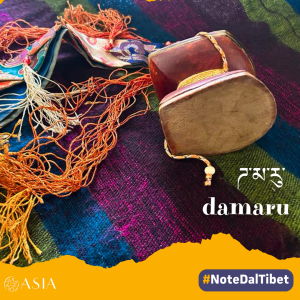 The ḍamaru is an ancient percussion instrument, unique of its kind, which originated in ancient India and was later adopted by the Himalayan regions presumably starting from the 8th century.
Characterized by a double drum, hourglass-shaped, it is often made of wood or, traditionally, of two inverted skull caps. Inside them there could be found precious mantras, written in gold.
Use and meaning
It is played by rotating it, so that the oscillating striker hits each side. Traditionally it is held by means of a thin cord in the right hand, the “hand of the method” usually accompanied in the Buddhist rituals by the bell, which is held instead in the left hand, the “hand of the wisdom”. The ḍamaru is often used by the Buddhist monks during the religious ceremonies and the meditation practices. The sounds produced by the instrument are considered purifying and capable of purifying the surrounding environment from negative influences.
The form with double drums of the damaru rappresenta spesso the duality of the universe, the harmony and the union of opposite forces such as the masculine and the feminine, the day and the night, and so on.
Dril bu, དྲིལ་བུ་
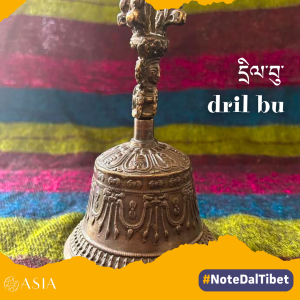 The dril bu is a bell with dorje (རྡོ་རྗེ་), a fundamental musical and ritual instrument within Tibetan Buddhism. Often used in religious ceremonies, in meditation practices and during teaching sessions.
It is composed of two main parts: the bell (dril) and the dorje (or vajra). The bell has a handle and a bell shaped like an upside-down bowl, while the dorje has a shape similar to a lightning bolt or to an object sharp at both ends. The bell represents the feminine principle, wisdom and emptiness, while the dorje represents the masculine principle, the method and compassion.
Symbolism
The sound of the dril bu, is believed to have purifying and protective effects. It represents the voice of wisdom calling the beings to awakening, while the sound of the dorje (when it strikes the bell) represents the cutting clarity of the awakened mind.
The bell and the dorje symbolize the complementary interaction of different aspects of reality. The bell represents emptiness, openness and spaciousness, while the dorje represents clarity, precision and active energy. Buddhist practice aims at integrating these aspects, reaching a harmonious balance between wisdom and compassion.
Role in the Ceremonies
The dril bu is often used during the religious ceremonies, as an integral part of the tantric rituals and of the meditation practices. In the tantric ceremonies, the sound of the dril bu is used to indicate different phases of the practice and to represent the union of the opposites in the search for the ultimate truth.
Dungchen, དུང་ཆེན་
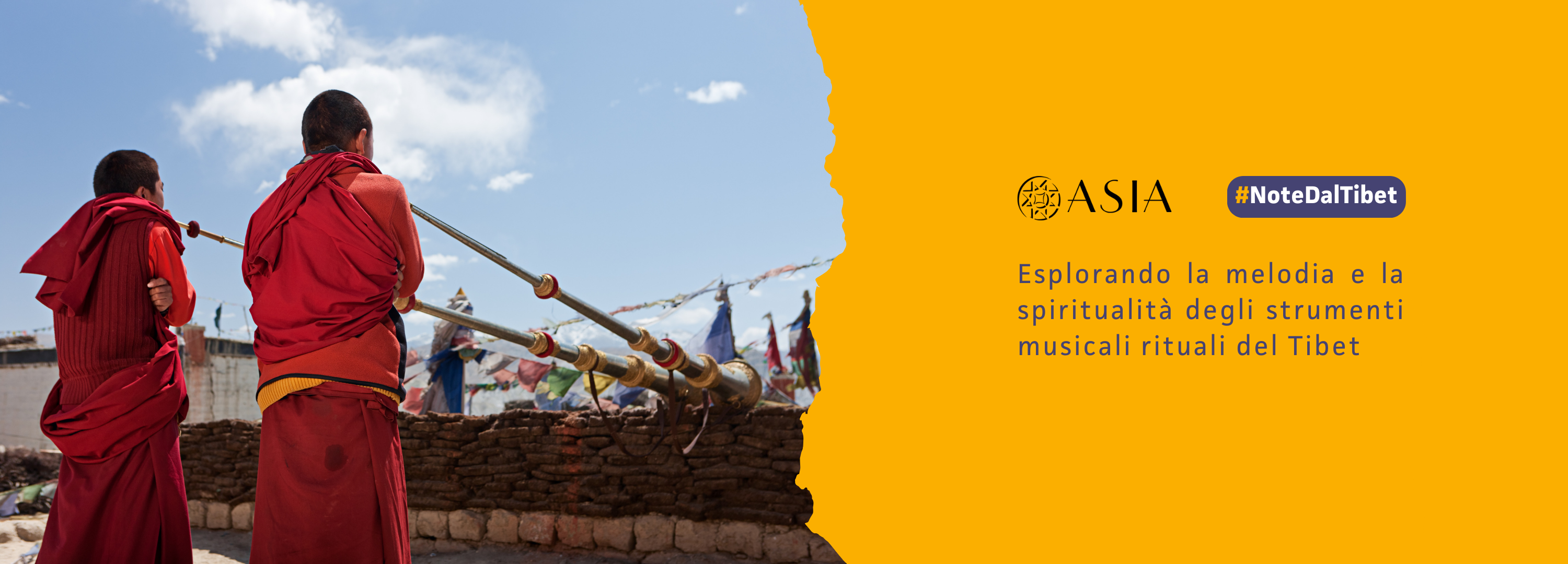
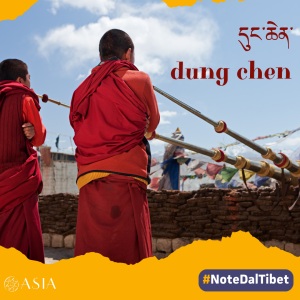 Also known as “long horn”, the dungchen is an iconic wind instrument of Tibet. It has a long tube of wood or metal of considerable size. It is used mainly in the Buddhist religious ceremonies, in order to produce a sacred, majestic sound that aids contemplation.
At the upper part of the tube there is a bell that amplifies the sound, while the lower part is often curved.
Use and meaning
The dungchen is widely used in the Buddhist religious ceremonies of all the traditions of Tibet. Its powerful sound is considered a means to attract the attention of the deities and of the spiritual beings, as well as to purify the environment and to drive away negative influences.
Its sound is a bridge, a channel of communication with the spiritual world. Indeed, given the variety of the melodies that can be played, the sound of the dungchen is often associated with the different qualities of the Buddhist deities and with the different phases of the spiritual practice.
Moreover, the powerful and penetrating sound can represent the renunciation of the ego and of distraction, thus facilitating concentration and meditation.
Dungkar, དུང་དཀར་
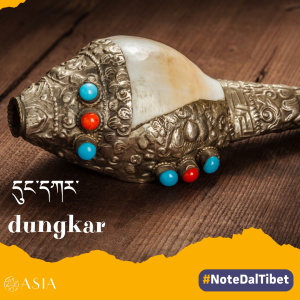 The conch, also known as dungkar in Tibetan (lit. “white conch”), is a traditional musical instrument of spiritual character both in Tibet and in other Himalayan regions. This wind instrument is made starting from the conch of a marine mollusk and, through the use of waxes or other materials, specific openings are created.
Its sound is powerful and penetrating, similar to the sound of a horn or of a trumpet, and it is also able to travel remarkable distances.
Use and meaning
In Tibetan Buddhism the right-turning white conch is one of the symbols of good auspice. Its sound represents the primordial sound, melodious and omnipresent, of the teachings of the Buddha. The sound of the conch is used to begin the religious ceremonies, to signal significant moments and to invoke blessings.
Kangling, རྐང་གླིང་
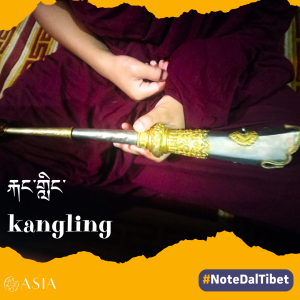 The kangling, or kangdung, is a traditional musical instrument that has a very particular and profound symbolism within Tibetan Buddhism and that goes beyond the mere sound and sensory experience.
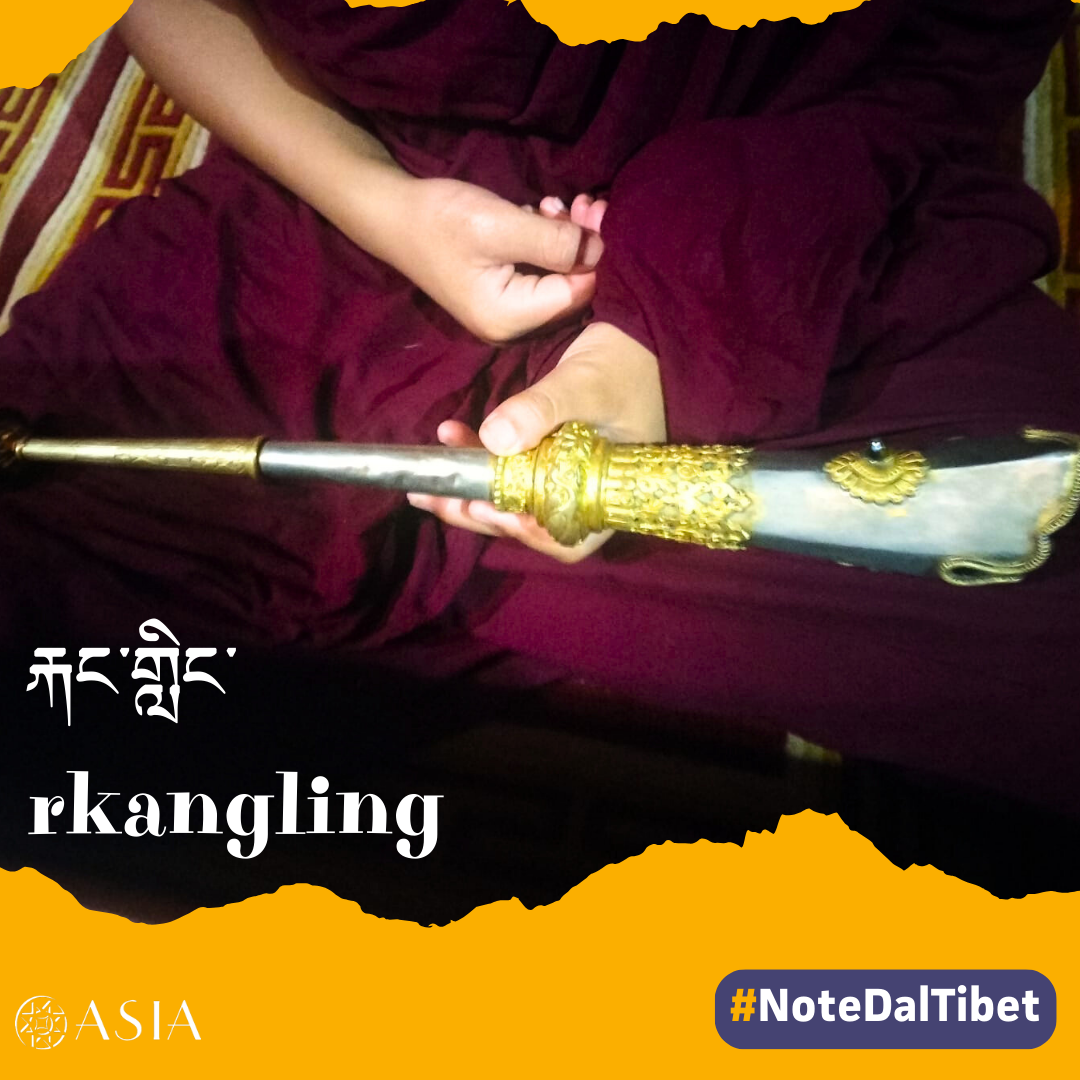
This wind instrument is a horn made of a human bone, often the femur, or of an animal bone, such as the sheep or the goat. It is made by carving the bone so that it resembles a horn. Sometimes it is also produced entirely in metal, as in the version you see in the photo.
Associated with the call of a bird, this sound is usually shrill and loud.
Use and meaning
The kangling is often used during the tantric practices and the ceremonies of transmission of spiritual teachings. It is played as part of rituals, to purify the environment, to drive away the negative forces and to facilitate the achievement of a deep meditative state. From a symbolic point of view, it is believed that the sound of the kangling has the ability to transcend the attachment to material objects and the fear of death, considered by Tibetan Buddhism as obstacles to the spiritual realization. It is therefore believed that the sound of the kangling can be an instrument of spiritual elevation, which can guide the practitioner to a deeper awareness of the nature of reality.
Respect and sensitivity
It is important to point out that the use of the kangling requires a great respect and sensitivity towards the deceased and the cultural traditions. It is therefore fundamental to treat such instruments with the utmost regard and with an understanding of the symbolic and spiritual importance they represent.
Pubblicato il
28/09/2023