
News & Media
Between mountains, encounters and small steps: our Civil Service in Nepal
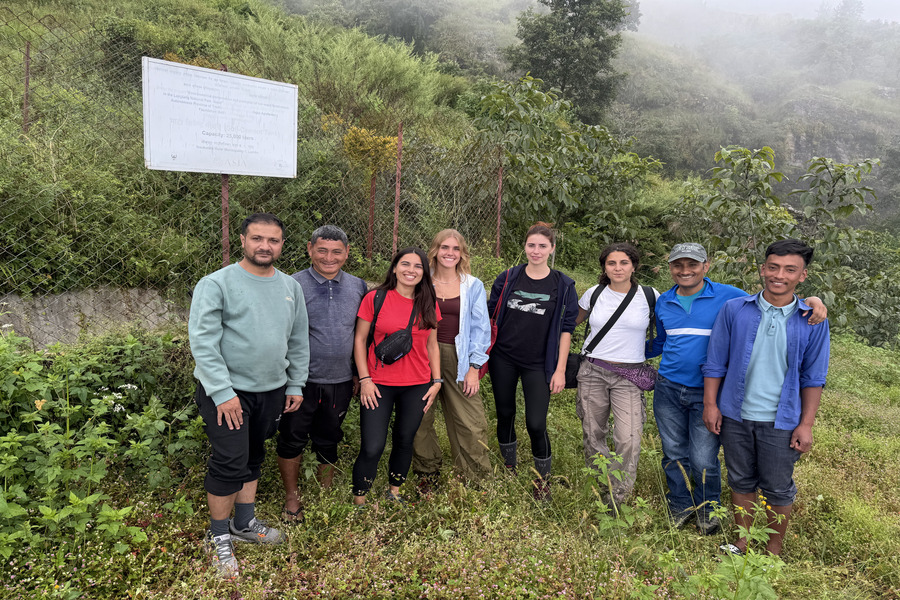
An encounter of few words
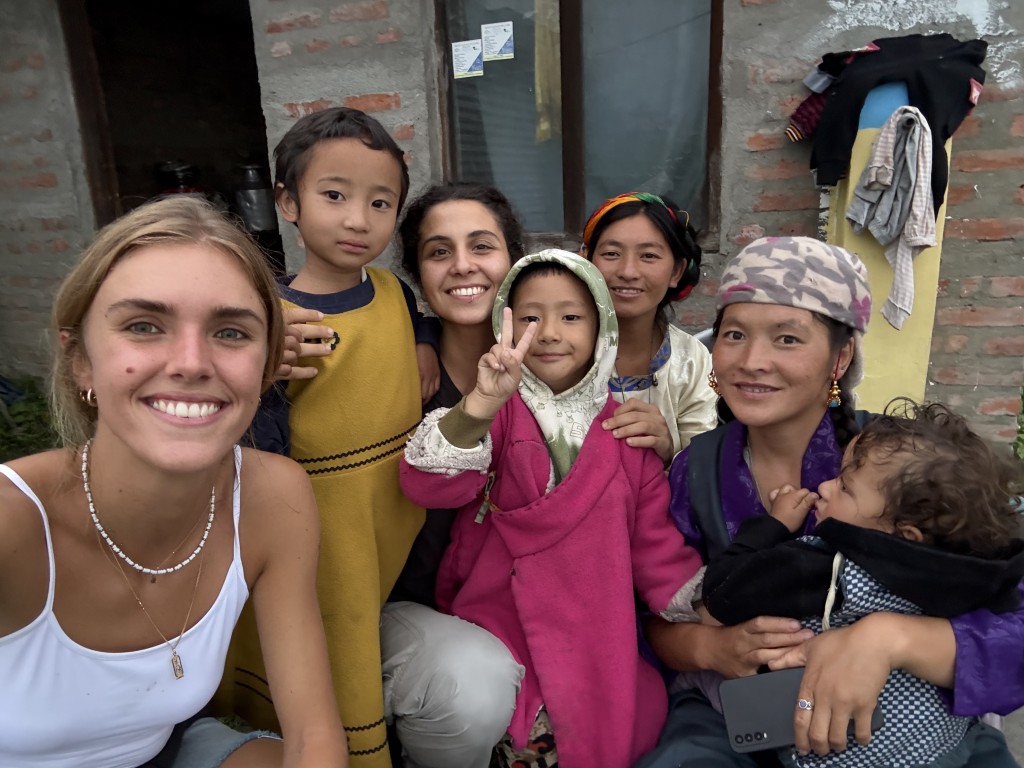
A lady is watching me with a funny expression, she seems curious about me. She must be at least as curious as I am about her. She wears big earrings that fall onto her shoulders, stretching her already dilated lobes. On her head she has a hat in bright colours. The clothes she wears are also extremely colourful: several overlapping layers, each one of a different shade. I cannot make out how old she is, her face bears the wrinkles of sun and work.
She smiles at me, furrowing her brow and tilting her head, and says something to me in Nepali that I interpret as “and who are you, and what are you doing here?”. We are in a remote village among the mountains of Nepal, under the watchful gaze of Mount Langtang. I answer her with a smile, which makes hers even bigger.
How I wish I could speak her language, be able to understand what she says to me and be able to answer her too. Instead I have to make do with this unusual exchange of smiles, words in different languages, movements of eyes and eyebrows. I must admit, though, that it seems to me we are talking even like this. It is a meeting between two people from very far away and different places, who for a moment recognise each other in the same time and the same space.
Why we chose the Universal Civil Service with ASIA
Encounters like this are part of our life here, and are among the reasons that led us to choose the Civil Service with ASIA. We are Federica, Francesca, Sofia and Adelaide and we left Italy at the end of July for a year of service in Nepal.
When we first met, we immediately sensed that our paths were intertwining for similar reasons: we felt the desire to have an experience that would give us the chance to build something useful, and that at the same time would make us grow, learn and marvel. We wanted to explore a new part of the world, to meet its inhabitants, to understand its problems from within, and to contribute, in our own small way, to change.
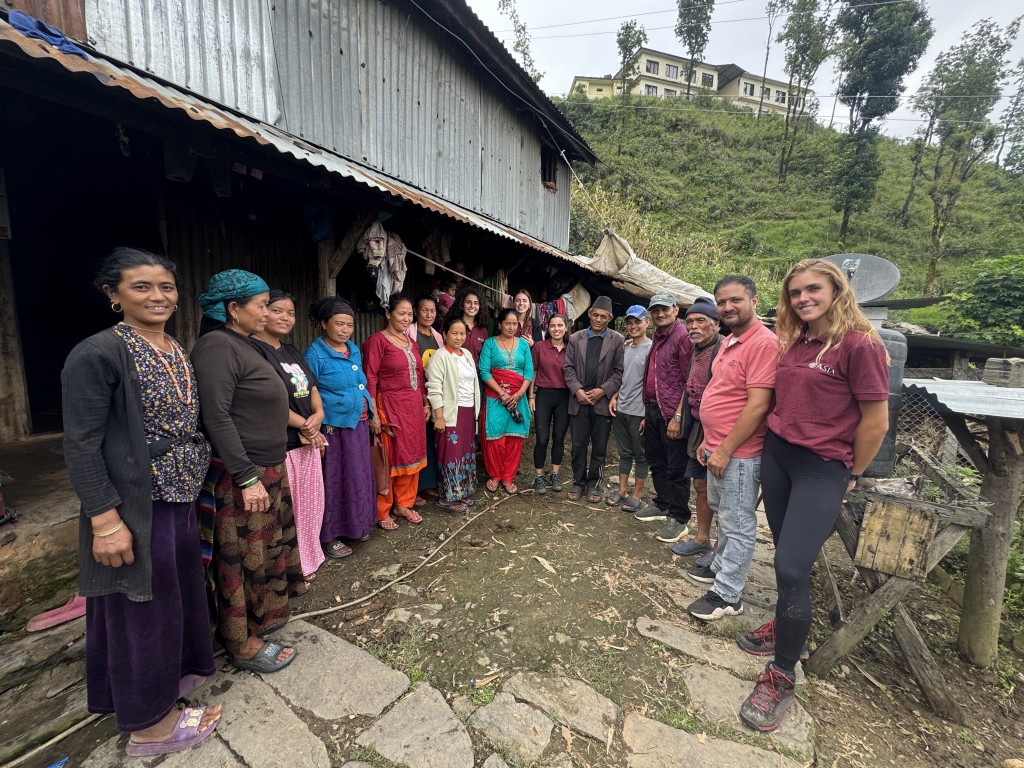
The project and the work in Kathmandu
Our project, “Designing for the future: resilient agriculture in Nepal”, aims to contribute to the improvement of the living conditions of rural communities, building with them the tools to withstand climate change and achieve food security. In Kathmandu we are part of ASIA’s operational office, where we were welcomed right away with great kindness by our colleagues Choenyi, Dependra, Emanuele, Nabaraj, Nhidi and Junu, making us feel welcome.
So far we have already learned many things: from interpreting the language of donors to preparing proposals for funding calls, from designing new activities to research and field data collection, up to monitoring the projects already under way. These are just some of the skills we have started to develop in these first five months of service.
When we go to the field
About once a month we leave the city to reach the areas of intervention, where we come into contact with the living reality of the projects. In particular in the Rasuwa district, in Naukunda, we support the monitoring of the agroforestry systems of coffee and beekeeping; and in Gatlang, where ASIA intends to create and launch new projects.
In these remote villages, where distance is measured in hours of walking and life is highly precarious, the effects of climate change manifest themselves as very concrete obstacles: unpredictable harvests, seasonal droughts and extreme winters undermine food security, making the life of local communities harder every day.
Seeing with our own eyes the places and the faces of the beneficiaries gives a deep meaning to the work we do in the office. Working with ASIA means for us being part of a reality that actively contributes to causes we believe to be right and necessary. Being part of a group of people who have chosen to devote part of their life to meeting other people and to supporting those who need it most.
Life in Kathmandu
As for life in Kathmandu, we settled in quickly: the city, apparently chaotic and disorderly, reveals itself, at a closer look, to be harmonious and with an order of its own.
What struck us from the very start was the extreme kindness of the Nepalese people and their sincere sense of welcome; their calm and tranquillity, like when they sit for hours watching what happens in the street; their unusual skills, like carrying very heavy objects balanced on their heads, or even wardrobes and mattresses on scooters; their exuberant and joyful celebrations, with dances, costumes, songs and traditional foods, which go on tirelessly for hours and days.
We are more and more fascinated every day by this culture that deeply interweaves Buddhist and Hindu religion, colouring orange, yellow and red the streets and the inhabitants of Kathmandu. Walking through the streets of the city or of the villages, it can happen, at any time, to come across ceremonies, rituals and moments of prayer, or to smell the scent of incense reaching our nostrils. All it takes is turning a corner to find the sacred, which coexists without boundaries with everyday objects.
Looking ahead
Living this experience is giving us countless resources and tools, thanks to which we are able to explore more deeply the world inside and outside of us. They push us to ask ourselves more questions, and show us where to look to find the answers.
In this second part of our experience, we intend to continue the work we have started with the designing in Gatlang, and to continue the monitoring in Naukunda. The awareness we have matured makes us understand how being here is, first of all, a privilege: having the possibility to explore a place and a culture so closely is something precious that we will keep forever.
On the other hand we are also aware that what we can give to this place is certainly a very small part of what would really be needed. Sometimes, seeing the amount of problems this country has to face can be discouraging. The difficulties appear extremely complex to us and sometimes almost impossible to overcome.
But the truth is that to climb a mountain, even the highest one in the world, you have to take one step after another. Our hope is that, along the way, the small steps we have taken may have left a concrete help for those who will continue the journey.
Pubblicato il
31/03/2026