
News & Media
‘cham, the ritual dance of the Tibetan new year

Losar, the Tibetan new year
The Tibetans celebrate Losar, the arrival of the new year, in two ways. On one side there is a religious tradition, lasting one single day, on the other a popular tradition, lasting 15 days. The first involves a true monastic ritual, whose purpose is to dissipate all the negative traces of the year just ended. This ritual unfolds as follows.
️On the first day of Losar the monks perform in private a long prayer and a tantric ritual. Through a ritual dance, called “cham” (‘cham) which lasts all day, they invoke the tantric deities so that they grant their protection. Then, they head outside the monastery in a procession during which they carry a gigantic sculpture, called “goutor” (dgu gtor), in which all the evil spirits and the negative tendencies are nestled. Finally, they set fire to the sculpture, to ward off all the unfavourable presences of the past.
The ‘cham dance
The ‘cham dance is very intense and evocative. Only the initiated monks, who have studied, visualised and practised at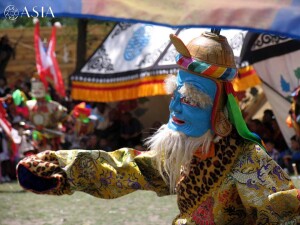 length the special sequences of this dance, can perform it. It is a masked dance, whose dancers generate and identify with tantric deities in order to tame and discipline the destructive aspects of reality, that is, to drive out the evil spirits, to free themselves and the participants from mental obscurations, to ensure the well-being of the community, health and long life, in order to best begin the new year.
All of this happens through a complex set of different rites: purification rites, invocations and offerings to various deities, specific dance steps, mudrā, music with a driving rhythm, acts of subjugation and expulsion of negative forces.
The history of the ‘cham dance in the Tibetan tradition
According to some legends, the ‘cham dance arrived in Tibet in the eighth century, when King Songtsen Gampo called from India Guru Rinpoche (Padmasambhava) to subdue the evil spirits that were hindering the construction of the Samye monastery, destroying every night what had been bui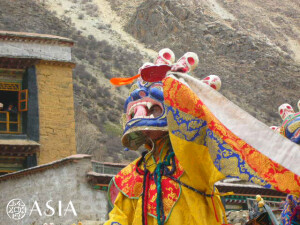 lt during the day. So, Guru Rinpoche presented himself there precisely at night, traced special lines (thig) in all the directions of space to trap the hostile demons and, after a brief ritual, practised for a long time a ritual dance (gar ‘cham), prevailed over the evil spirits and managed to purify the space. However, to learn more one has to wait a good seven centuries, when the fifth Dalai Lama wrote an important dance manual, the ‘cham yig, a most important text because it was the first to illustrate in detail the ritual dance (gar ‘cham) of Guru Rinpoche, extolling it to the point of defining it “the origin of tantra”. In any case, the fifth Dalai Lama distinguished this dance, which he precisely called tantric, into two types: gar, in which hands and arms mostly move, and ‘cham, in which feet and legs mostly move.
Nga dbang Chos ‘byor, a gelupa dance master, later explained that gar is performed as a very slow and calm ritual dance, not masked and not public, since it can be danced only by and in the presence of initiated monks. He then adds that it is simply preparatory to the ‘cham dance, much more intense and “fierce”, open to the public.
The ceremony is a true three-dimensional mandala
Gar and ‘cham still today are two moments of the same ceremony. The ceremony takes place in an open space, often a courtyard, which must be protected by a pavilion or a tent. It usually has a square shape which, meeting the circular movements of the dancers, will give rise to a three-dimensional mandala. The mandala is a cosmogram, that is, a drawing or a representation (gramma) of the micro- and the macro- cosmos.
At the centre of the courtyard two poles are installed, joined and adorned with rows of coloured pennants, on a rectangular base of stone or clay, which often serves as an altar for the offerings to the fierce deities of the ‘cham, so that they eliminate the hostile forces. The centre is also the place where the main ritual activities take place; it is indeed the point where the officiating priest and the first dancer are placed, the latter in fact embodying the most important ‘cham deity. The centre is the focus of the whole performance, which radiates outwards thanks to the many dancers whirling clockwise or counterclockwise.
Nor are the musicians missing, sitting on the ground usually on the opposite side of the main door leading to the monastery or the temple, because it is precisely through that door that the deities will pass to then incarnate themselves in the dancers.
Often concentric circles are marked on the ground with chalk, as if to divide the outer space from the inner one, that is, the centre, inhabited by the deity, heart of this two-dimensional and three-dimensional mandala which is the ritual space.
In reality there are several mandalas involving different levels of this ceremony. The first is the one traced on the ground, in secret, after performing sa gar, the dance of the earth, whose purpose is to define the boundaries of the ritual space by creating an inner and an outer circle, an upper and a lower circle. Sa gar is performed with five dance steps and is transformed into a mandala thanks to the officiant who, after invoking and paying homage to ten wrathful deities so that they protect the space from evil spirits, symbolically projects the emblems of the five families of the Buddha (buddha, vajra, jewel, lotus, karma) first under the soles of his feet and then in five directions, so that they cross the whole sacred space, which, finally, is totally purified. Then, again in secret, a macrocosmic mandala is created, that is, the three spheres of existence are invoked and blessed, giving them a symbolic form on the ground: the first sphere is depicted with a celestial wheel with eight points, the second with the eight auspicious symbols typical of Buddhism, the third with an eight-petalled lotus. A further mandala appears at the microcosmic level in the body, the speech and the mind of the dancers and the musicians, once they enter the sacred space. The last mandala is the fundamental one: the ground beaten by the dance steps, where the mandala turns into action action and performance.
The ‘cham dance creates and transforms
Thus the mandala is not a simple drawing, a simple representation or a symbolic re-enactment of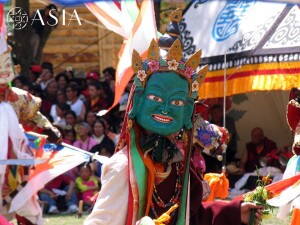 something else; here it is a very special tool. It is a means to take control of a place and transform it into a sacred space, summoning the power that dwells in it by eliminating the aspects that pollute it or are potentially destructive. This power, then, through the dance is transferred from the ritual space to the dancers, who in turn pass it on to the participants.
Well then, just as the ‘cham dance operates in a space of creation and transformation, we hope that Losar may be for everyone a passage, an opportunity to transform difficulties into possibilities, to make a clean sweep, let go of the destructive seeds and create new spaces, as in a dance.
 On 14 February 2021 we are waiting for you to celebrate together the Tibetan New Year, a free online event to discover Tibetan culture.
How to take part? You can find all the info here
Bibliography
Dipankar Khanna & J. Shashi Kiran Reddy, Vajranŕtyam: a Phenomenological Look at the Cham or Lama Dance as a Meditative Experience
Ellen Pearlman, Tibetan Sacred Dance, a journey into the religious and folk traditions
Michael A. Rappenglück, The whole world put between to shells: The cosmic symbolism of tortoises and turtles
Mona Schrempf, Taming the Earth, Controlling the Cosmos
Pubblicato il
08/02/2021